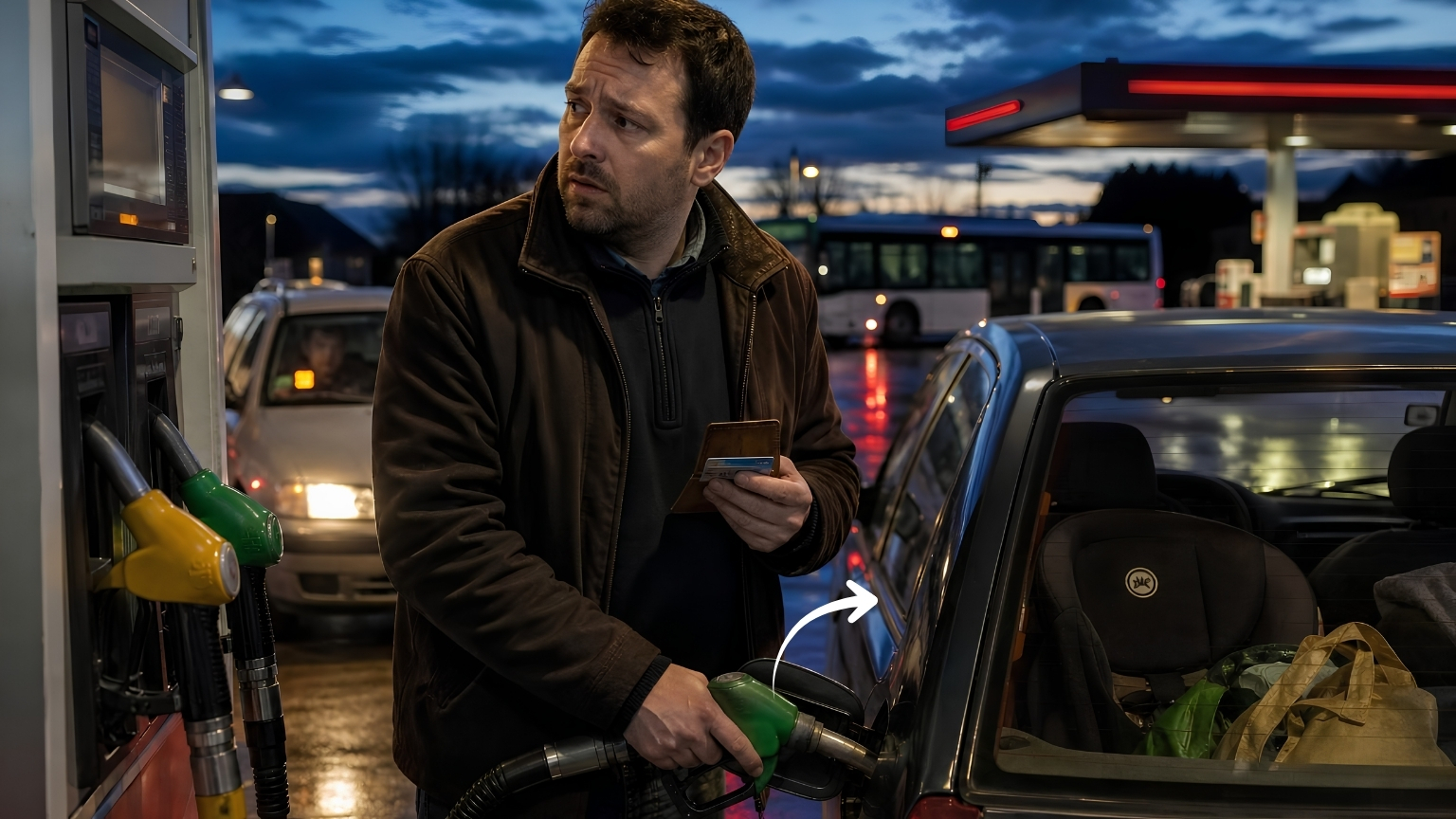
The decision can happen before anyone reaches a petrol station. A driver looks at the distance to a friend’s house, remembers what the last fill-up cost, and decides to stay home. Another combines the supermarket, pharmacy and family visit into one trip. The car still works; the household budget is what has changed.
In France, both petrol and diesel have recently been above two euros a litre. On 20 September 2026, an analysis of prices reported by service stations put diesel at about €2.41 a litre nationally and SP95-E10 petrol at more than €2.17. Those are dated averages, not the price at every pump today, but they explain why even an ordinary journey can prompt a second thought.
This is not simply a story about people driving more carefully. Some are deciding which journeys they can afford to make at all. The hardest choices often concern the trips that give daily life its shape: seeing relatives, taking children somewhere at the weekend, or travelling beyond the nearest shops.
What gets cut first
For someone who can take a bus to work or walk to the shops, leaving the car at home may be inconvenient but manageable. For someone whose workplace has no practical public-transport connection, the commute is less negotiable. That tends to push the savings onto everything around it. A visit becomes less frequent; an outing waits until it can be combined with another errand.
A 2026 mobility survey reported by TF1 Info gives a sense of the pressure. It found that 48% of respondents sometimes forgo a journey to save money, while 47% felt they had no real choice of transport for their daily travel. The same report put average monthly mobility spending at €225, excluding the purchase of a vehicle. These figures describe survey responses and overall mobility costs; they do not mean every missed journey was caused by the latest rise in fuel prices.
The distinction matters. Choosing to walk a short distance instead of driving can be a welcome change. Missing a meeting with a friend because the fuel bill is too high feels different. Both reduce car use, but only one necessarily reflects greater freedom.
The petrol pump tells part of the story
National fuel consumption has fallen, though the numbers alone cannot tell us exactly which journeys people have abandoned. Road-fuel deliveries in August were 6.6% lower than a year earlier, including a 9.2% drop for diesel, according to industry figures reported by Le Monde. Deliveries over the year to that point were down 5% compared with the same period in 2025. The report noted that higher prices are one factor alongside the economic slowdown and longer-term changes in the vehicle fleet.
At the household level, the calculation is more immediate. At €2.17 a litre, 50 litres of petrol costs €108.50; at €2.41 a litre, the same quantity of diesel costs €120.50. That example is not a claim about what every driver pays or how often they fill up. It shows why a sum that was once absorbed into the weekly routine can start competing with other expenses. The litre prices reflect the reported averages of 20 September.
People respond in ways that rarely appear in a statistic. They may wait for several errands before starting the engine, ask whether a meeting can happen by phone, or plan a family visit around another necessary journey. None of these adjustments is dramatic on its own. Together, they can make a person’s world a little smaller.
Not everyone can park the car
The ability to drive less depends heavily on where someone lives. In an Insee study based on 2019 census data, 86% of employed rural residents travelled to work by car, compared with 70% of workers overall. Public transport accounted for just 2% of rural workers’ commutes. Those figures predate the current price surge, but they show why the advice to “take the bus instead” often misses the reality of rural life.
Distance compounds the problem. In the same study, half of employed rural residents travelled about 13 kilometres or more to work each way. A worker might be able to postpone a shopping trip, but not a shift. For people with fixed hours, caring responsibilities or several places to reach in one day, a car can be less a preference than the means of making the timetable work.
There is an inequality hidden inside the phrase “use your car less.” A person with nearby services has choices that a person far from them may not. If the essential kilometres cannot be cut, the reduction falls elsewhere. Leisure is often the first thing to go, but the consequences can reach further: the 2026 mobility survey reported difficulties affecting access to medical appointments, work and training as well.
Saving fuel without giving up every trip
Drivers who must keep using their cars still have ways to limit consumption, although none makes an unaffordable journey affordable for everyone. The most useful changes are often modest: grouping errands, sharing a suitable commute, and comparing nearby stations before filling up. France’s official fuel-price website lists station prices and availability; station operators update prices when they change. A cheaper pump helps only if reaching it does not use up the saving.
Driving style and vehicle upkeep matter, too. France’s environmental agency, ADEME, says reducing motorway speed by 10 km/h can save between one and three litres over a 500-kilometre journey, depending on the vehicle. It also recommends smooth driving, removing unused roof equipment and keeping tyres properly inflated. These measures reduce fuel use, but their benefit depends on the car and the journey.
Sharing a ride may offer a more substantial change when two people have compatible routes and schedules. It is not always easy to arrange: school drop-offs, variable shifts and last-minute changes can make a regular lift impractical. Still, unlike simply cancelling a trip, it can let people keep travelling while using fewer cars. The right answer is therefore likely to differ from one household to the next.
The broader challenge cannot be solved at the pump alone. A fuel-price comparison tool may ease a bill; it cannot create a bus route or bring a workplace closer. For households that have little choice but to drive, cheaper alternatives depend on the transport available where they actually live, not where policy assumes they live.
For now, the car parked outside may tell two very different stories. Its owner might have found a convenient way to make a short trip without it. Or they might have stayed home when they wanted to go out. As petrol and diesel remain costly, understanding that difference is essential: fewer journeys do not always mean better choices.

Je suis Pauline Roussel, journaliste culinaire et consultante en arts de la table depuis plus de quinze ans. Diplomee en management de l’hotellerie-restauration a l’Institut Paul Bocuse et ancienne critique gastronomique pour un guide regional Gault&Millau, j’ai explore cuisines de terroir et tables etoilees. Mon travail m’a menee des bistrots parisiens aux auberges familiales italiennes, avec une attention particuliere pour le lien entre gastronomie, voyage et art de recevoir a la maison. Je partage ici mes experiences concretes, mes methodes d’organisation et mes adresses preferees pour aider chacun a cuisiner mieux et accueillir avec confiance.
Story follow-up
- BMW avait osé cette petite bombe de 170 ch en 1973 : la 2002 Turbo était en avance sur son époque
- Elle avait 0,5 ch et quatre roues : pourquoi cette étrange machine de 1885 est considérée comme la première moto
- Volkswagen agrandit l’ID. Buzz Cargo : 4,4 m³ et 340 ch pour séduire davantage les professionnels
- La H24EVO change radicalement de technologie : Toyota lui confie un V6 hydrogène de près de 900 ch
- Ce SUV Geely peut réellement avancer sur l’eau : voici à quoi servent ses étonnantes hélices
On the same subject
 BMW avait osé cette petite bombe de 170 ch en 1973 : la 2002 Turbo était en avance sur son époque
 Elle avait 0,5 ch et quatre roues : pourquoi cette étrange machine de 1885 est considérée comme la première moto
 Volkswagen agrandit l’ID. Buzz Cargo : 4,4 m³ et 340 ch pour séduire davantage les professionnels
 La H24EVO change radicalement de technologie : Toyota lui confie un V6 hydrogène de près de 900 ch
 Ce SUV Geely peut réellement avancer sur l’eau : voici à quoi servent ses étonnantes hélices
 À Bakou, George Russell gagne pour 196 millièmes après une dernière frayeur